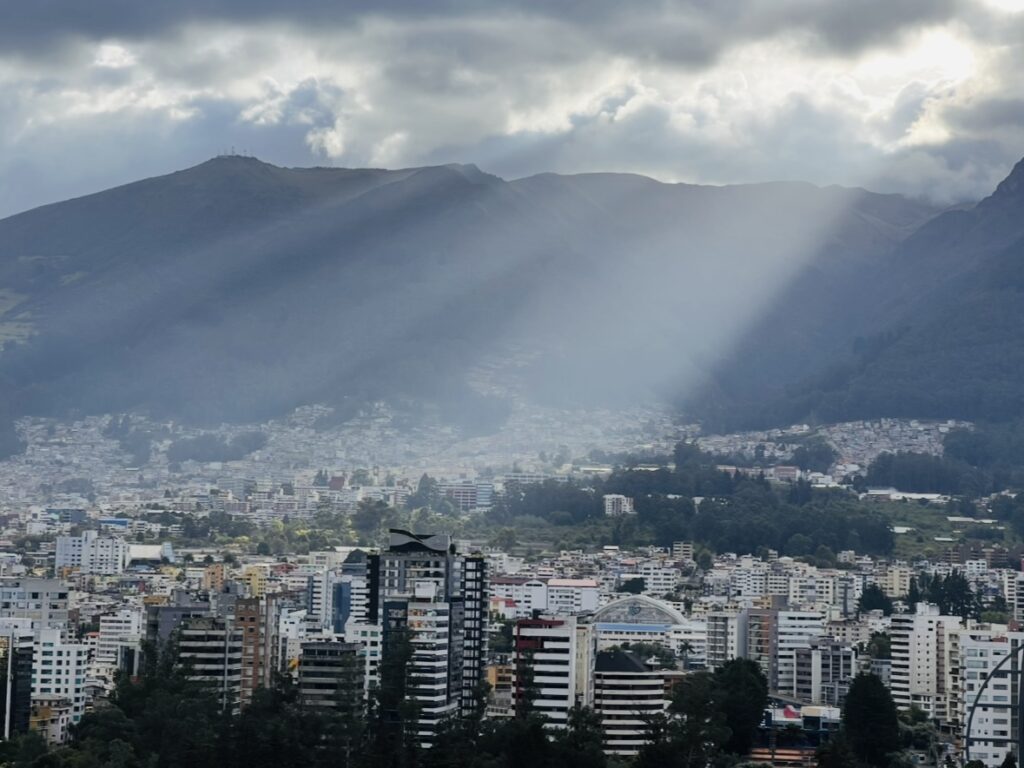
If you are planning a trip to Ecuador, there is a very good chance the Galápagos Islands are the main event on your itinerary. For most, stopping in the capital city of Quito is treated as nothing more than a mandatory layover—a quick place to grab a night of sleep after a long international flight before catching an early connection out to the islands. However, after spending time exploring both the mainland and the islands, skipping Quito entirely is a huge missed opportunity.
Quito sits high in the Andes mountains at over 9,300 feet (2,850 meters) above sea level, making it the second-highest capital city in the entire world. It offers a completely different perspective on South America, combining dramatic mountain landscapes with unique local culture. If you structure your time well, giving yourself a few days in Quito before heading to Galapagos gives you a fantastic warm-up to Ecuador.
What to Know Before You Go: Safety and Logistics
Before getting into what to see, it helps to understand the practical realities of navigating Quito.
On the financial side, Ecuador uses the US dollar as its official currency. Tipping is typically 10-15 percent at restaurants, so make sure to factor that in everywhere you go in Ecuador and in Galapagos. Also I found restaurants and shops to be much cheaper than in Galapagos. So I would recommend buying any forgotten toiletries or souvenirs on the mainland.
Safety, requires a bit of practical awareness. Quito is generally manageable during the day if you pay attention to your surroundings, but it is not a city where you want to wander around aimlessly after dark. A good rule of thumb is to avoid walking around at night altogether. Instead, stick to Ubers or ask your hotel or restaurant to call a trusted taxi service for you. During daytime sightseeing, keep your phone tucked safely inside a zipped pocket or bag rather than walking down the sidewalk with it held out in your hand.

The Elevation Reality: What 9,000+ Feet Actually Does to Your Body
Even if you consider yourself in peak physical condition, climbing a simple flight of stairs at your hotel will leave you breathing noticeably heavier than usual. Beyond feeling slightly winded when moving around, high elevation impacts your body’s physiology in two very specific ways that catch a lot of first-time travelers off guard:
• Frequent Headaches: Because the air is significantly thinner up in the Andes, there is less oxygen entering your bloodstream with every breath. To compensate, the blood vessels in your brain expand (dilate) to try and pull in more oxygen, which can create light pressure and mild headaches during your first 24 to 48 hours.
• Waking Up Gasping for Air: This is easily the weirdest biological phenomenon you will experience while acclimatizing. When you are awake, your conscious brain manually keeps your breathing pace steady regardless of blood gas levels. But the second you fall asleep, control switches to your automatic reflex system. Because of the thin air, your automatic system triggers rapid breathing to pull in extra oxygen. That rapid hyperventilation causes CO2 levels to plunge, then your automatic brain gets confused. You stop breathing for a few seconds until your oxygen drops low enough that your brain freaks out, sends a tiny rush of adrenaline, and jolts you awake to take a quick, deep breath.
To help your body cope with all of this, give yourself a slow first day or two, stay hydrated and consider keeping basic pain relievers like ibuprofen nearby.
Top Things to Do in Quito
• Mitad del Mundo (Middle of the World): more on that later…
• Teleférico & Volcán Pichincha: A high-altitude cable car that lifts visitors up the eastern slopes of Pichincha Volcano to over 13,000 feet (4,000 meters). You can ride to the top for great views of Quito or as the starting point for the trek toward the summit.
• Basílica del Voto Nacional: The largest neo-Gothic cathedral in the Americas, famous for replacing traditional European gargoyles with native Ecuadorian wildlife like tortoises, iguanas, and armadillos.
• Centro Histórico (Old Town): A UNESCO World Heritage site recognized as one of the largest and best-preserved colonial centers in Latin America.
• El Panecillo: A volcanic hill in central Quito topped with a 148-foot aluminum statue of the Winged Virgin Mary (kind of like the Christ the Redeemer statue in Brazil)
Popular Day Trips from Quito
• Cotopaxi National Park: Located roughly 1.5 to 2 hours south of Quito along the “Avenue of the Volcanoes,” this park is home to one of the world’s highest active volcanoes.
• Quilotoa Crater Lake: An emerald-green lake formed inside a collapsed volcanic caldera roughly 3 hours southwest of Quito.
• Otavalo Indigenous Market: About 2 hours north of the capital, Plaza de Ponchos in Otavalo hosts one of South America’s most famous indigenous artisan markets. Indigenous Quichua weavers sell handwoven alpaca blankets, traditional ponchos, and silver jewelry.
Mitad del Mundo
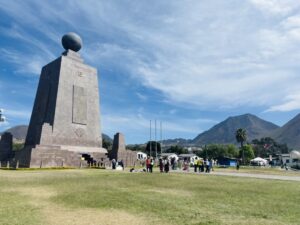
Located roughly 45 minutes from central Quito, Mitad del Mundo (which translates directly to “Middle of the World”) is the famous equatorial monument site where you can stand with one foot in the Northern Hemisphere and one foot in the Southern Hemisphere.
It is a fun, classic tourist stop, but it also doubles as one of the absolute best places to shop for local artisan goods. Since we didn’t have a chance to shop any of Ecuador’s famous street markets, this is where we were able to find handmade jewelry, ponchos, classic tourist T-shirts, magnets, sombreros de toquilla (AKA Panama hats) and more. I highly recommend buying these sort of things at small shops or markets instead of the airport or in Galapagos if you want to save money. I was a bit disappointed by souvenirs in Galapagos, especially after finding one clearly marked made in china mug for 15 USD, after buying most of souvenirs for 2-5 USD in mainland Ecuador. In defense of Galápagos it is an isolated archipelago roughly 600 miles off the coast, so almost every single resource, food item, and supply has to be shipped in by boat or cargo plane. This combined with heavy tourist demand mean prices on the islands are marked up significantly.
Craft Beer and Microbreweries
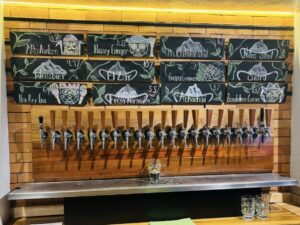
One of the cooler surprises about modern Quito is its thriving local craft beer scene. If you enjoy microbreweries, districts like La Mariscal and González Suárez are filled with great local spots serving up fantastic IPAs, stouts, and pale ales brewed right in the Andes.
However, there is a golden rule every traveler needs to follow: wait at least two or three days to acclimate before touching any alcohol.
Full disclosure: I waited 4 full days before having any alcohol and despite this I still got a headache after just one beer.
Drinking alcohol at high altitude affects you much faster than it does at sea level. It dehydrates your system almost instantly, suppresses your breathing further while you sleep, and makes altitude headaches drastically worse. So as always drink responsibly!
On a side note, if you plan on taking high-altitude day trips out of the city—such as hiking up the volcanic slopes of Cotopaxi—avoid both alcohol and caffeine completely prior to the trek. Both substances spike your resting heart rate and dehydrate your lungs at the exact moment you need every drop of oxygen you can get.
Is Quito Worth the Stop?
If you treat Quito simply as an annoying logistical hurdle on your way to see giant tortoises, you’re missing out. But if you give it at least two or three days on your itinerary, respect the elevation, use common sense with safety, and take advantage of the affordable food and local markets, it serves as the ultimate start to your South American adventure.
Plus, setting up camp in Quito opens the door to one of the most thrilling day trips on the continent: a hike up one of the highest active volcanoes on Earth, Cotopaxi. I will be breaking that down in the next post!
For more of our adventures check out these other posts: